
Background
Lepidopteran pests — the caterpillars and borers behind fall armyworm, pod borer, diamondback moth and fruit and stem borers — are among the most destructive threats in agriculture, able to erase yield across cereals, vegetables, fruit and cotton. To control them, growers have come to depend on synthetic diamides such as chlorantraniliprole: potent, systemic, and effective even against larvae boring deep inside the plant.
But that dependence carries a rising cost. Repeated use is driving resistance in key pests, eroding the very efficacy growers rely on. Synthetic residues increasingly clash with tightening export MRLs and the clean-label expectations of premium markets, and can burden pollinators and beneficial insects. Most botanical alternatives, meanwhile, act only on contact, break down quickly, and cannot reach the concealed, boring larvae that do the greatest damage.
What was missing was a botanical that could match a synthetic diamide on its own terms — systemic movement within the plant, and control of lepidopteran pests comparable to chlorantraniliprole — but residue-free, resistance-managing and export-friendly. Hi Cell Eradico was developed to meet exactly that need.
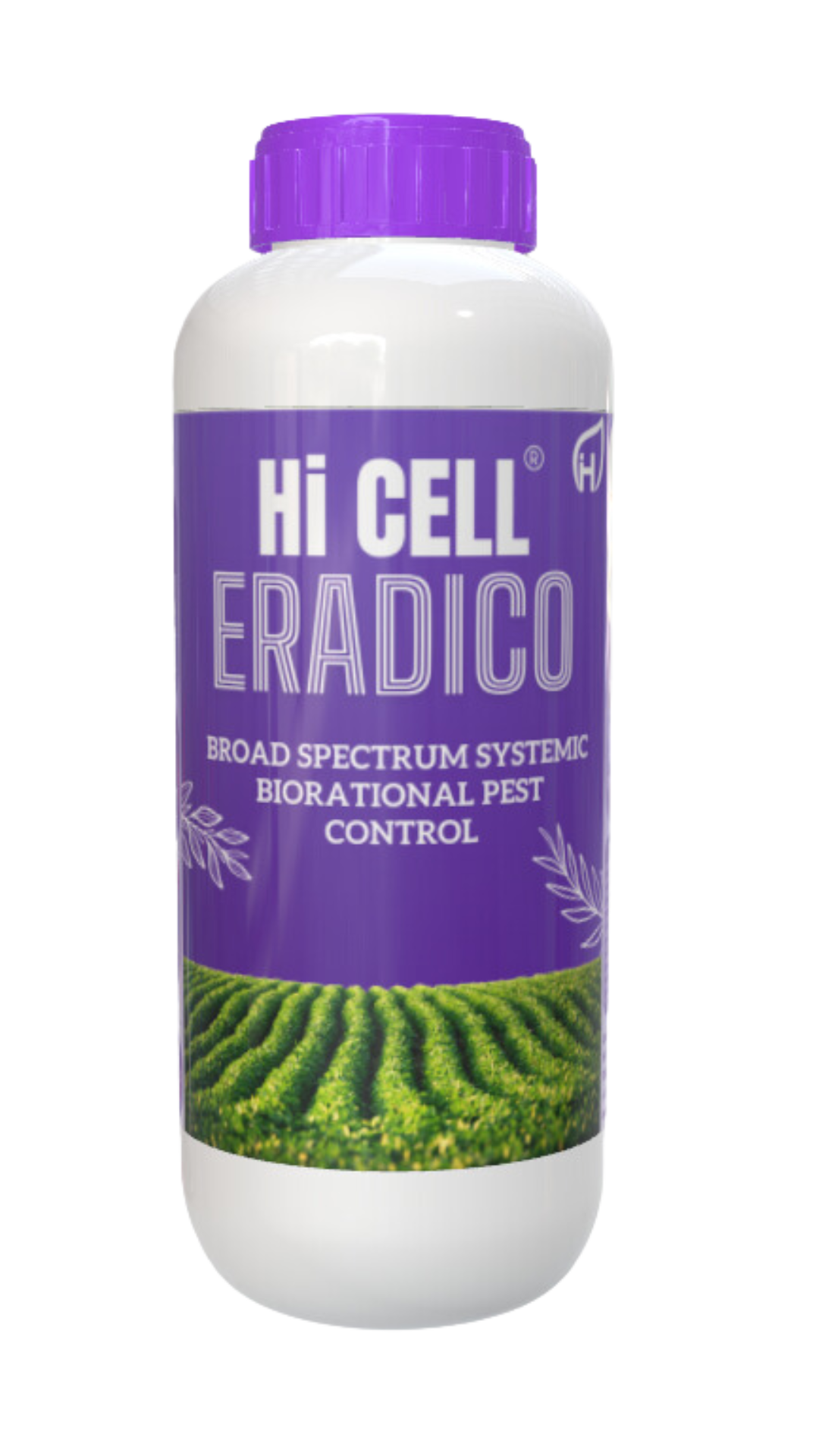
Hi Cell Eradico
Hi Cell Eradico is a broad-spectrum, systemic biorational pesticide built on a simple insight: in the wild, plants defend themselves against insects with natural antifeedant compounds — defences largely bred out of modern high-yield crops. Hi Cell's scientists isolated these potent antifeedant factors from commonly consumed herbs and spices using green extraction technology, and formulated them into Eradico.
Applied to the root zone, Eradico is absorbed and moves systemically through the plant within about 48 hours, protecting it from within. Because it travels upward from the roots, it controls pests without leaving residues on leaves or fruit — and with a pre-harvest interval of zero. Its antifeedant action starves feeding pests, giving a median knock-down time under 72 hours and field protection of 12–15 days.
Eradico works across lepidopteran, hemipteran and thysanopteran pests at very low doses (around 70 g/acre), with zero toxicity to mammals, aquatic life and soil flora. Soil-applied residues degrade quickly, and it carries a complementary growth-promoting effect on the crop — a safe, versatile tool for modern horticulture.
Eradico efficacy vs chlorantraniliprole & cyantraniliprole
Diamide firepower. Without the diamide time-bomb.
Chlorantraniliprole and cyantraniliprole set the modern standard for caterpillar control. Eradico meets it — then breaks through the ceiling those molecules are trapped under.
On raw control, Eradico plays in the same league: ~85–90% efficacy, median knock-down under 72 hours. But it doesn't fade as fast. Eradico holds the field for 12–15 days — against roughly 5–10 for chlorantraniliprole — and does it at a pre-harvest interval of zero, while the diamides force growers to wait days before they can pick. Like cyantraniliprole, Eradico is genuinely broad-spectrum, taking down sucking pests — aphids, thrips — alongside chewing larvae, reaching far past chlorantraniliprole's narrow lepidopteran lane.
Then the knockout. Chlorantraniliprole and cyantraniliprole are the same chemistry — both IRAC Group 28, both ryanodine-receptor modulators, one shared mode of action. Resistance to one is resistance to both — and it's already spreading across fields worldwide. Every spray locks growers deeper into a class that's burning out. Eradico strikes through a completely different mechanism — antifeedant starvation — carrying zero cross-resistance to the diamides. It's the rotation partner that resets the board.
Now stack the rest: zero mammalian and aquatic toxicity, while the diamides carry documented aquatic-invertebrate hazard; residue-free systemic delivery; full organic compatibility. The verdict writes itself — Eradico delivers diamide-class power, without diamide-class baggage.