
Background
Post-harvest loss destroys 30–40% of global fruit production — billions in value erased between farm and shelf. Yet incumbent solutions leave the problem wide open. 1-MCP acts on ethylene alone, failing entirely on non-climacteric fruit like cherries, grapes and citrus — a vast, underserved segment. Surface coatings only slow moisture loss, and synthetic treatments are colliding with tightening residue limits and the accelerating clean-label shift. The result is a large, growing market with no solution that addresses the actual biology of senescence across crop types. That gap — real, quantifiable, and unmet by today's leaders — is precisely the opening Renova was built to capture
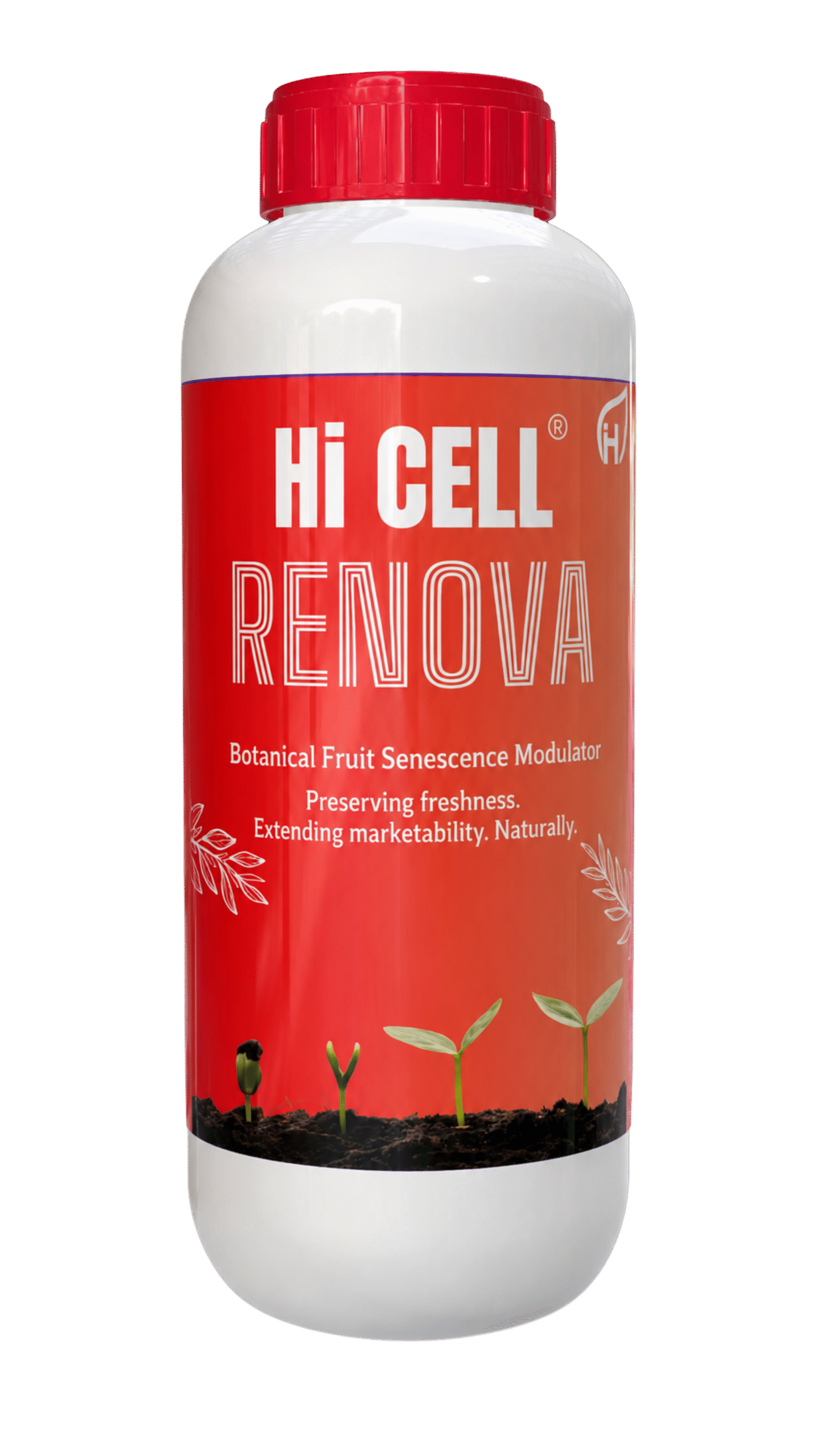
Hi Cell Renova
Renova is our flagship botanical treatment for postharvest freshness — engineered to keep fruit firmer, brighter and more flavourful, for longer. Rather than sitting on the surface like a coating, Renova works with the fruit's own biology, gently inhibiting the eight enzyme and ethylene pathways that drive ripening and decay: PME, PG, cellulase, xylanase, PPO, LOX, β-galactosidase and ethylene biosynthesis.
This multi-pathway action is what sets Renova apart. Unlike 1-MCP, which targets ethylene alone and fails on non-climacteric crops, Renova performs across both climacteric and non-climacteric fruit — cherries, grapes, bananas, citrus and more. It preserves firmness, colour, flavour and Brix through long cold chains, protecting premium quality and export value.
Residue-free and OMRI Compliant, Renova is validated across 50+ trials at TRL 7. Applied simply at the packhouse by dip or spray. Nature's answer to farm-to-shelf loss.
Efficacy
Renova's strength lies in how broadly it acts. Fruit ripening and decay are driven not by one process but by a cascade of enzymes working in parallel — and Renova inhibits eight of them at once. It targets the cell-wall softening enzymes PME, PG, cellulase, xylanase and β-galactosidase that turn firm fruit soft; PPO, responsible for browning; LOX, which generates off-flavours and membrane breakdown; and ethylene biosynthesis, the master switch of ripening. By addressing the whole cascade together, Renova preserves firmness, colour, flavour and Brix far longer than single-mode methods.
This is where it departs from the alternatives. 1-MCP blocks ethylene perception alone — effective on some climacteric fruit, but useless on non-climacteric crops like cherries, grapes and citrus, where ripening isn't ethylene-driven. Surface and wax coatings take a purely physical route, forming a barrier that slows moisture loss and gas exchange without touching the underlying enzymatic biology of senescence.
Renova does neither. It works with the fruit's own physiology across both climacteric and non-climacteric crops — a genuinely broad-spectrum treatment, not a single-target chemical or an external coating. That difference is why it performs where the others cannot, validated across 50+ trials.