
The mulberry may be the most perishable fruit of all — so soft and skinless that, untreated, it lasts barely a day or two. That is why it is almost never seen beyond the farm gate: a crop trapped in hyper-local, hyper-seasonal markets by its own fragility. Across three trials spanning the full supply chain — ambient, cold storage, and the cold-to-shelf transition — Renova transformed that fragility, holding firmness by as much as +248% and extending marketable life from 1–2 days to 5–10. Renova is a botanical treatment that targets the softening enzymes directly.
A crop the supply chain can’t currently reach
Most fruit gets a few days to travel and sell. The mulberry gets almost none — it softens, bleeds and collapses within a day or two of picking, which is why you rarely find it in a supermarket at all. That single limitation, not demand, is what confines it to roadside and farm-gate sale. Renova was tested against exactly that constraint, across three storage conditions that map to the real supply chain: ambient farm and wholesale, ten-day cold-chain export, and the temperature swing from cold store to retail shelf. It held firm in all three.
Why 1-MCP backfires on mulberry
The conventional ethylene blocker doesn’t just underperform on mulberry — it can make things worse. In cold storage 1-MCP lifted firmness only 11%, and in the cold-to-shelf trial it came in 13.68% below untreated fruit — actively worse than doing nothing. In thin-skinned berries the receptor block is overcome, and the delayed ethylene release triggers a rebound of accelerated softening. Because Renova acts on the downstream softening enzymes directly rather than on the ethylene receptor, it avoids that rebound entirely.
The enzyme pathways Renova targets
Mulberry deterioration is enzymatic and oxidative — the cell walls break down, the deep colour bleeds, and membranes collapse within days. Renova acts across these pathways together.
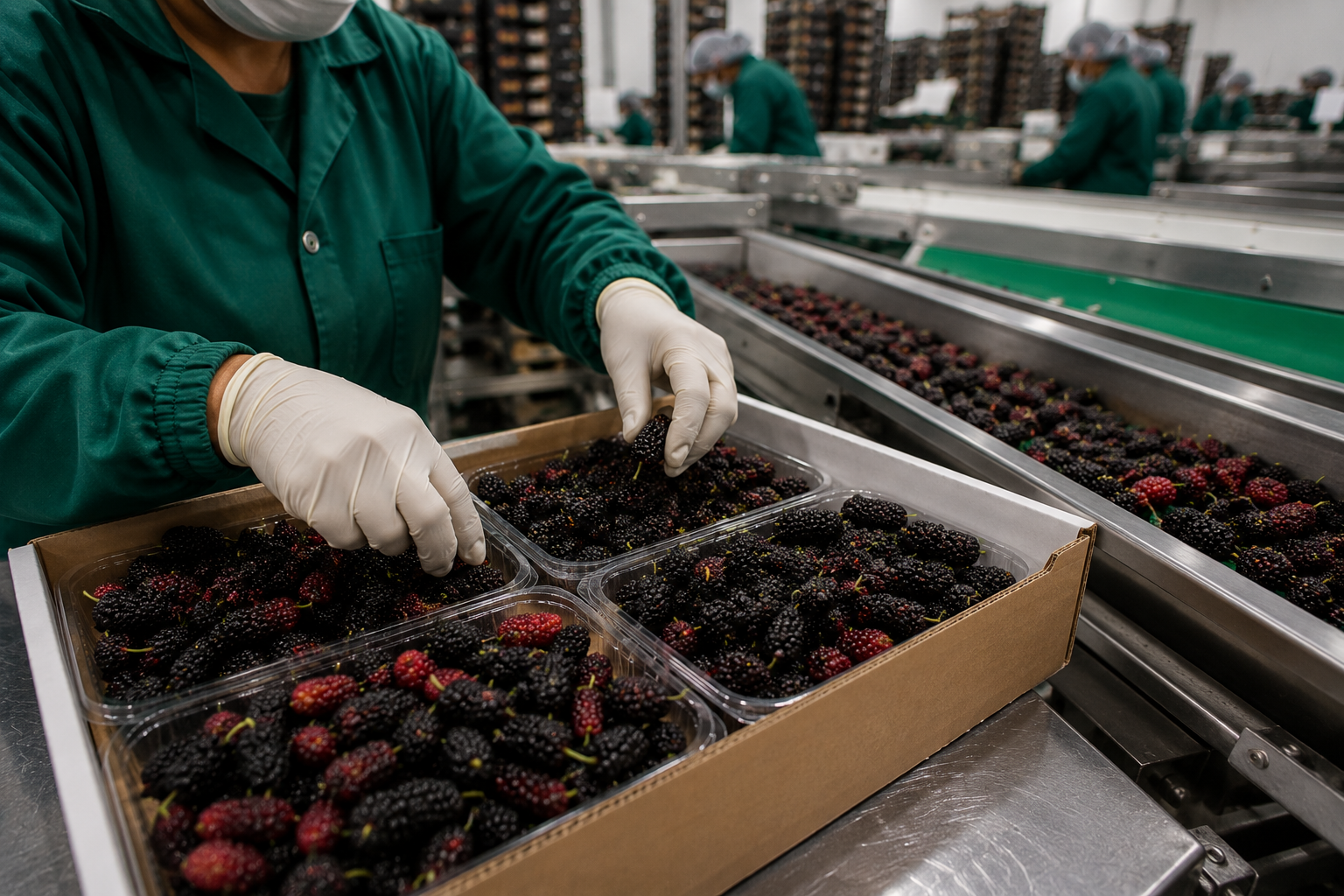
Proven across the whole supply chain
Three mulberry trials at Pune, India, each mapped to a real distribution scenario. In ambient storage, Renova-VOL at 10 ml/L held firmness 248% above 1-MCP — the most dramatic firmness result of the series. In the cold-to-shelf transition, Renova-VOL EP retained firmness 184% above untreated fruit. Treatment effects were highly significant throughout.
The bottom line. Some fruit never reaches the shelf because it simply cannot survive the trip — and no fruit proves that harder than the mulberry, marketable for barely a day or two untreated. Across three trials spanning ambient, cold, and the journey between them, Renova held mulberries firm where 1-MCP backfired, extending marketable life to as much as ten days. That is not a marginal gain — it is the difference between a crop confined to the farm gate and one that can finally travel.