
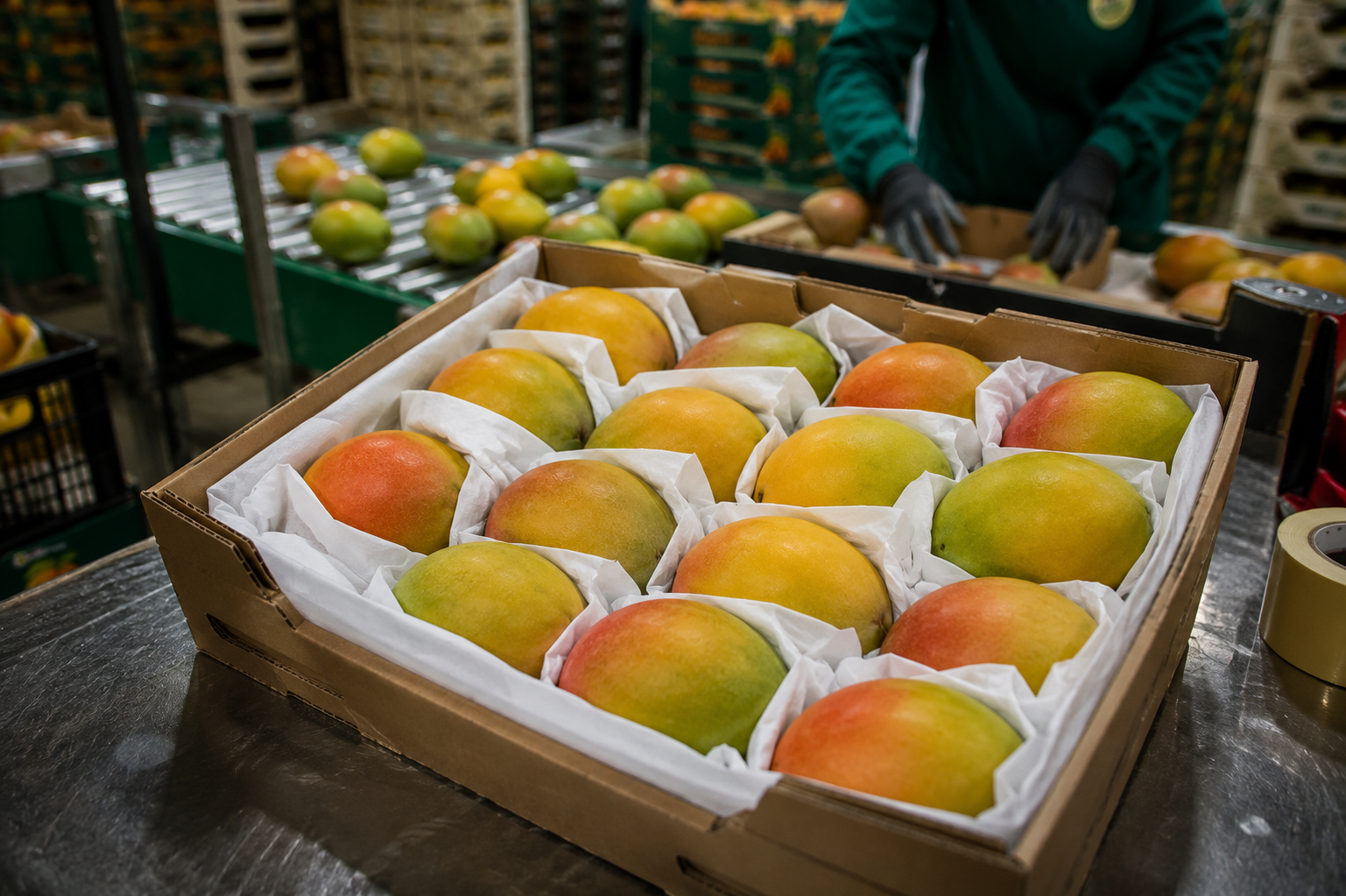
Mango — the king of fruits, and one of India’s great exports — is climacteric and famously perishable. It softens fast, and fastest of all once it leaves the cold chain for the warm retail shelf. Hi Cell Renova is a botanical treatment that modulates the whole ripening cascade at once. In a trial spanning 20 days of cold storage plus up to a week at ambient heat, Renova-treated fruit held firmness through the ambient phase where mango normally collapses — while letting sweetness and flavour develop.
The hardest mile is the warm one
A mango’s real test comes after the cold chain. Held cold, most fruit holds up; but the moment it reaches the ambient retail shelf — often 30 °C and above — the ripening surge takes over and firm fruit can soften to waste within days. This trial was built to test exactly that transition: 20 days cold, then several days at ambient. 1-MCP can halt ripening, but it does so irreversibly — blocking the very sugar, colour and aroma development that make a mango worth eating. Renova takes a different route.
The enzyme pathways Renova targets
Mango ripening runs on several fronts at once — the flesh softens, the peel changes colour, and pulp starch converts to sugar. Renova modulates the enzymes behind all of them, plus the ethylene switch that sets them off.
Modulation that protects eating quality
The point of holding a mango firm is to still have a mango worth eating at the end. Because Renova modulates the enzyme cascade rather than blocking the ethylene receptor, firmness is retained while sweetness continues to develop — the trial measured Brix alongside firmness, and all six analyses across firmness and Brix were significant. In practice the standout was Renova-VOL EP 10 ml/L, which delivered the highest flesh firmness at both the 4-day and 7-day ambient timepoints (15.05 and 10.22 kg/cm²) — firm, saleable fruit that still ripens to full flavour.
Proven through cold storage and ambient shelf
Trial Hi Cell M2/03/2026 — mango, Pune, India, held 20 days in cold storage (13–16 °C) and then moved to ambient conditions (22–38 °C), with firmness and Brix assessed at 4 and 7 ambient days. Renova was tested across a dose range — including the OMRI-compliant grade — against 1-MCP and an untreated control.
The bottom line: Mango’s hardest test isn’t the cold chain — it’s the warm retail shelf that follows, where an exported mango can soften to waste in days. In a trial built to mimic exactly that journey — 20 days cold, then up to a week at ambient heat — Renova held firmness through the phase where mango normally collapses, while sweetness and aroma continued to develop. That is the difference between a mango that survives the journey and one that arrives worth eating.